
The main purpose of introducing competences into organisations is usually to improve the performance of employees, the team or the organisation as a whole. Competences or competence models represent the desired state towards which all HR processes are directed.
What are competences?
Competences are the combination of knowledge, skills and personal qualities that employees need to perform their job well. They can be divided into soft, psychological competences (e.g. persuasiveness, stress resistance, analytical thinking) and hard, professional competences (knowledge of Excel, Russian, SEO, etc.).
Each job requires a greater number of competences. But creating a list of competences is not helpful in recruitment activities. The most important competences need to be identified, organised hierarchically, ranked by job and defined by measurable behaviour. This organised system of competences is called a competence model.
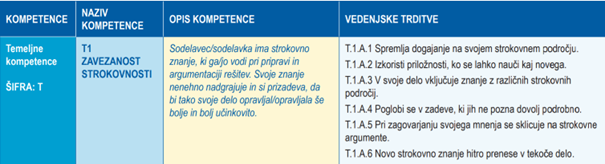
Example: extract from the competency model for the Police
Applying the competency model
Competences can be organised into competency models in different ways, with the needs of the organisation as the main guiding principle. Well-designed competency models form the core around which many HR activities revolve:
- HR selection. Candidates are screened for the expression of key competences.
- Development activities. We assess employees on competences. Development gaps are the subject of training and other development activities.
- Career planning. We guide employees to the areas of work where their competences are best expressed.
An example approach to building a competency model
At Primera, we strive for professional but intuitive, lean, easy-to-understand competency models. We build them with and for employees, so more people are involved in the process:
- Where possible, we help the client to assemble a project team with whom we coordinate key activities and solutions.
- Qualitative interviews with successful employees. We use questions and sub-questions to guide the employee to accurately describe his/her behaviour in situations where he/she has achieved above-average success.
- Integration workshops. After the interviews, we carry out a thorough analysis and identify the most important behaviours. In the workshops, participants intuitively combine the key behaviours into sets of competences.
- Focus groups. The draft competency models are tested and refined in focus groups.
- If the competences are intended for a large number of employees, the final versions are also verified by short surveys.
All forms of group work are highly interactive. They involve a lot of visually rich material and physical movement of elements. Together, we build a solution that is close to the users’ hearts and, as a result, easier for them to adopt as their own.
Sustainability of solutions
All competency models become obsolete after a certain period of time. In our models , we think about the competences that are key to success in the years to come. This extends the lifetime of the competence model. A method based on the involvement of HR staff leaves the organisation with a large amount of knowledge. Minor additions to the competency model can be made by the HR staff themselves, as they have been involved in all stages of the model’s development.
Extensive experience
We have a lot of experience in setting up competency models for different organisations. Models for private organisations are confidential, but we can share an example of a project we worked on with the Ministry of Public Administration: https://www.gov.si/zbirke/projekti-in-programi/projekt-vzpostavitev-kompetencnega-modela/.
We have also developed a competency model for the Slovenian Police. The project also produced a content-rich manual for assessing and developing competences in the Police: https: //www.policija.si/images/stories/Publikacije/PDF/Prirocnik_Presojanje_in_razvoj_kompetenc_maj2023.pdf
If you are interested in more information, please send an enquiry to info@skupinaprimera.si or call +386 40 467 750.


